Seniority is not about being the person with the most commands memorized. That helps, of course. Knowing your way around Linux, AWS, Kubernetes, Terraform, logs and a few broken dashboards is very useful, especially when production decides to express itself creatively.
But the real value of a senior engineer is not only technical depth. It is the ability to reduce ambiguity.
Messy problem, unclear owner, half-known architecture, missing context, urgent incident, product pressure, a Slack thread with twenty people and zero decisions. That is where seniority shows up. Not as magic, not as ego, not as the person who has an opinion about every tool ever created. As clarity.
Table of contents
Open Table of contents
- The short version
- Ambiguity is expensive
- The senior engineer as a clarity layer
- Incidents are ambiguity under pressure
- Architecture decisions need context
- A good ticket reduces risk
- The trap: becoming the human router
- What reducing ambiguity looks like
- Strong opinions, loosely held
- The best senior engineers make the system calmer
- Final takeaway
The short version
- Senior engineers are not valuable only because they know more tools.
- They are valuable because they reduce confusion, risk and rework.
- Ambiguity is expensive, especially during incidents and architecture decisions.
- A good senior engineer improves the quality of the question before jumping to the answer.
- Technical leadership is often the ability to create clarity without becoming the bottleneck.
Ambiguity is expensive
Ambiguity looks harmless at first: a vague requirement, a Jira card with weak acceptance criteria, an architecture decision that says “we will improve this later”, a service with no clear owner, a metric nobody knows how to interpret, a security exception nobody remembers approving.
None of these break production immediately, which is exactly why they survive. But ambiguity creates interest, like technical debt with a calendar, and eventually somebody pays. The bill never arrives on a calm afternoon. It arrives mid-incident, mid-migration, or in the middle of an audit, with the whole company watching.
A system can survive complexity. It has a much harder time surviving complexity that nobody understands.
If people cannot explain how a system should behave, they will struggle to debug it when it behaves differently.
The senior engineer as a clarity layer
A senior engineer should not just ask “How do we implement this?”. They should also ask:
- What problem are we actually solving?
- What happens if this fails?
- Who owns this after it ships?
- What assumptions are we making?
- What does success look like?
- What does rollback look like?
- What are we choosing not to solve right now?
These questions sound simple. They are not. They separate activity from progress, and they shrink work as often as they grow it. Half the time, asking “what problem are we actually solving?” reveals that the team was about to build a platform for something a ten-line script would handle. Ambiguity loves to disguise itself as a complex solution.
A junior engineer may focus on the task, a mid-level engineer on the solution. A senior engineer has to understand the system around the solution: architecture, people, cost, reliability, security, delivery pressure and future maintenance. The code is only one part of the blast radius.
Incidents are ambiguity under pressure
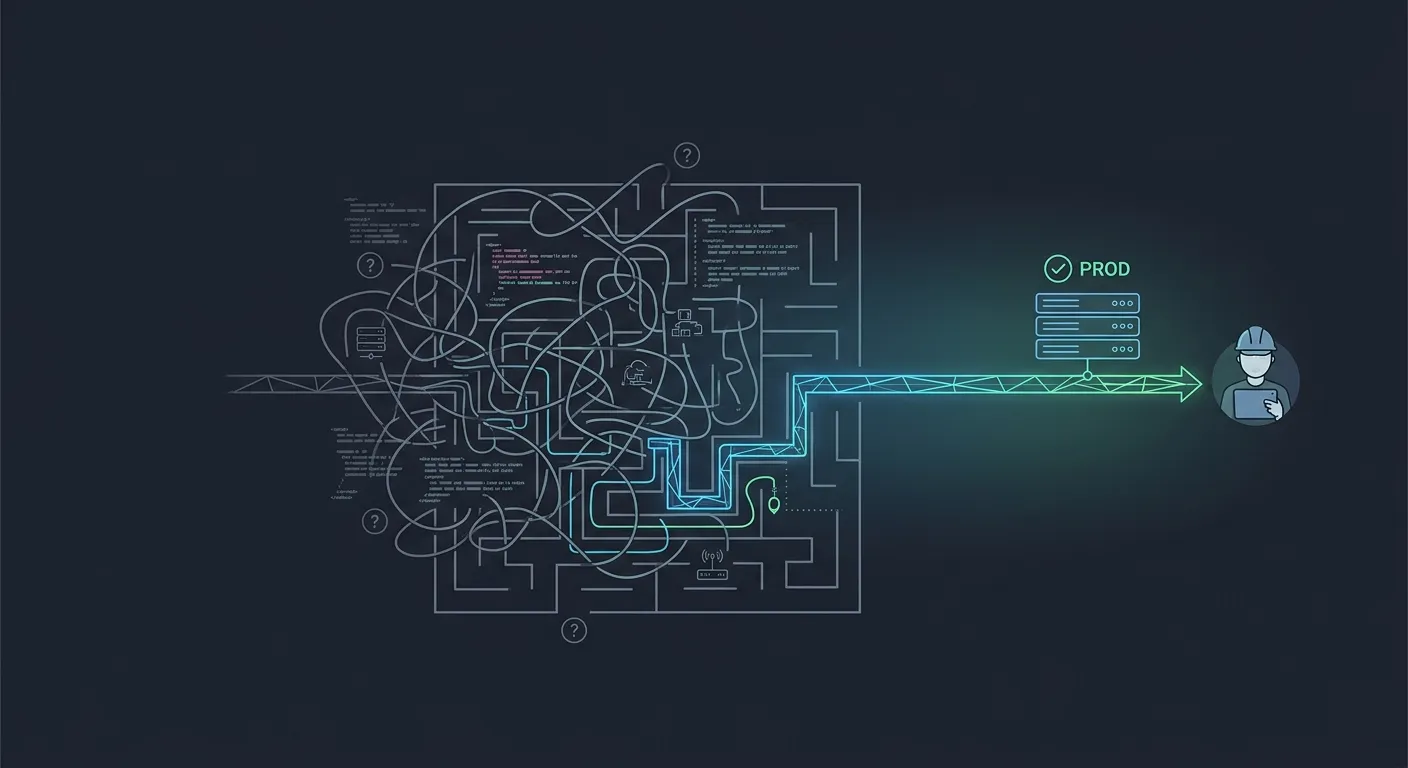
Incidents expose ambiguity fast. During normal work, unclear ownership is annoying. During an incident, it becomes expensive:
- Who owns the service?
- Where are the logs?
- Which dashboard matters?
- Is this customer impact or only internal noise?
- Can we roll back?
- Who can approve the change?
- Is this a platform, application, network or data issue?
When these answers are missing, the incident gets slower. Not because people are lazy, but because the system did not leave enough context behind. In the middle of an incident, nobody wants an archeological expedition. They want the next useful signal.
Bad incident context:
"The service is slow. Can someone check?"

Better incident context:
"p95 latency increased from 300ms to 2.4s after the 22:10 deploy.
Errors are concentrated on checkout-api.
Database CPU is normal.
Rollback is available.
Current impact: payment flow."
The second version does not solve the incident by itself, but it reduces guesswork, and that matters. A senior engineer does not need every answer immediately. They just need to make the room less confused after they enter it.
Architecture decisions need context
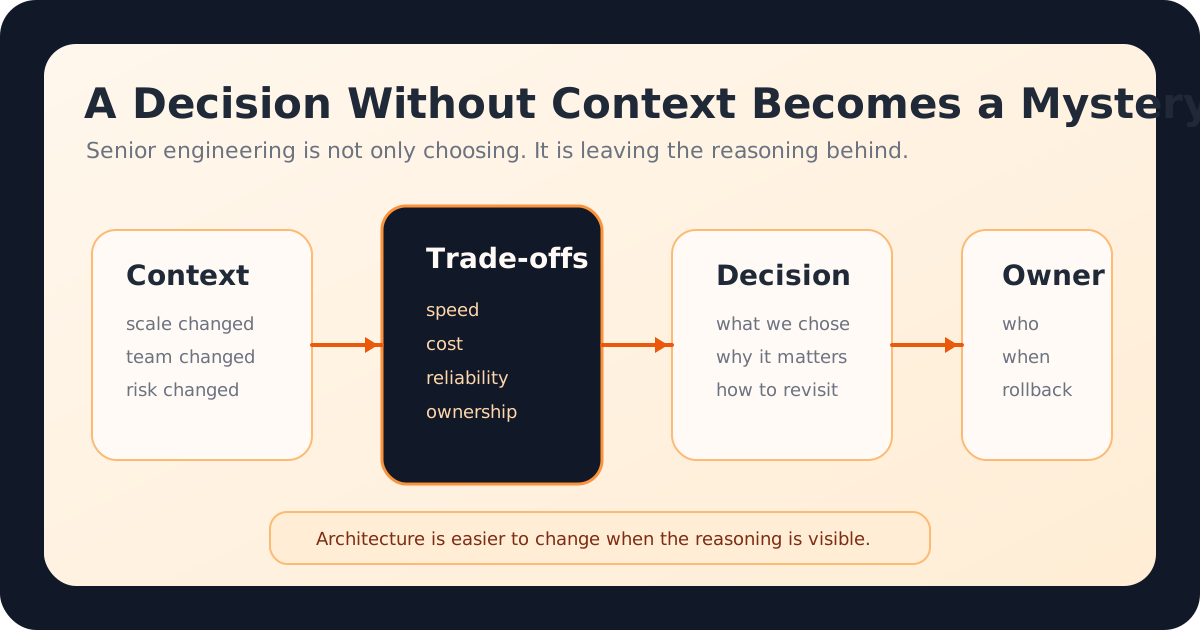
Architecture without context becomes decoration. A diagram can look clean and still hide the most important question: why was this decision made?
I have seen decisions that looked strange years later but made perfect sense at the time: different scale, different team, different budget, different urgency, different risk. That is why “this architecture is bad” is often a lazy conclusion. A better question is:
What was this architecture optimized for, and is that still true?That question changes the conversation, because the original goal was rarely random:
- maybe it was optimized for speed, or for cost
- maybe it was built before the team had Kubernetes experience
- maybe it assumed low traffic, or a single tenant
- maybe it assumed manual operations because automation was not worth it yet
The senior move is not to judge old decisions from a new context. It is to notice when the context changed.
A good ticket reduces risk
This may sound boring, but boring things keep systems alive. A weak ticket creates ambiguity, a good ticket creates alignment.
Bad ticket:
Improve observability.Better ticket:
Add latency, error rate and request volume metrics for checkout-api.
Create a dashboard with p50, p95 and p99 latency.
Add an alert when p95 latency stays above 800ms for 10 minutes.
Document the first three checks in the runbook.
The second ticket is not just more detailed, it changes the probability of success. It gives the engineer direction, the reviewer something to validate, and the team a shared definition of done. That is technical leadership. Not because writing tickets is glamorous (nobody joins engineering dreaming about acceptance criteria), but because unclear work creates rework, rework creates delay, delay creates pressure, pressure creates bad decisions, and bad decisions create incidents. Then everyone suddenly cares about clarity.
The trap: becoming the human router
There is a dangerous version of seniority where everything starts passing through one person: every design question, every production concern, every Terraform change, every incident, every security exception, every “quick question”.
At first it feels useful. Then it becomes a reliability problem. If a team cannot move without one person in the room, that person is not just helping the platform, they are becoming part of it. And humans are terrible single points of failure. We need sleep, sometimes coffee, sometimes silence, often all three.
The goal of seniority is not to make yourself required for every decision. It is to leave enough context, patterns and guardrails that other people can make good decisions without waiting for you.
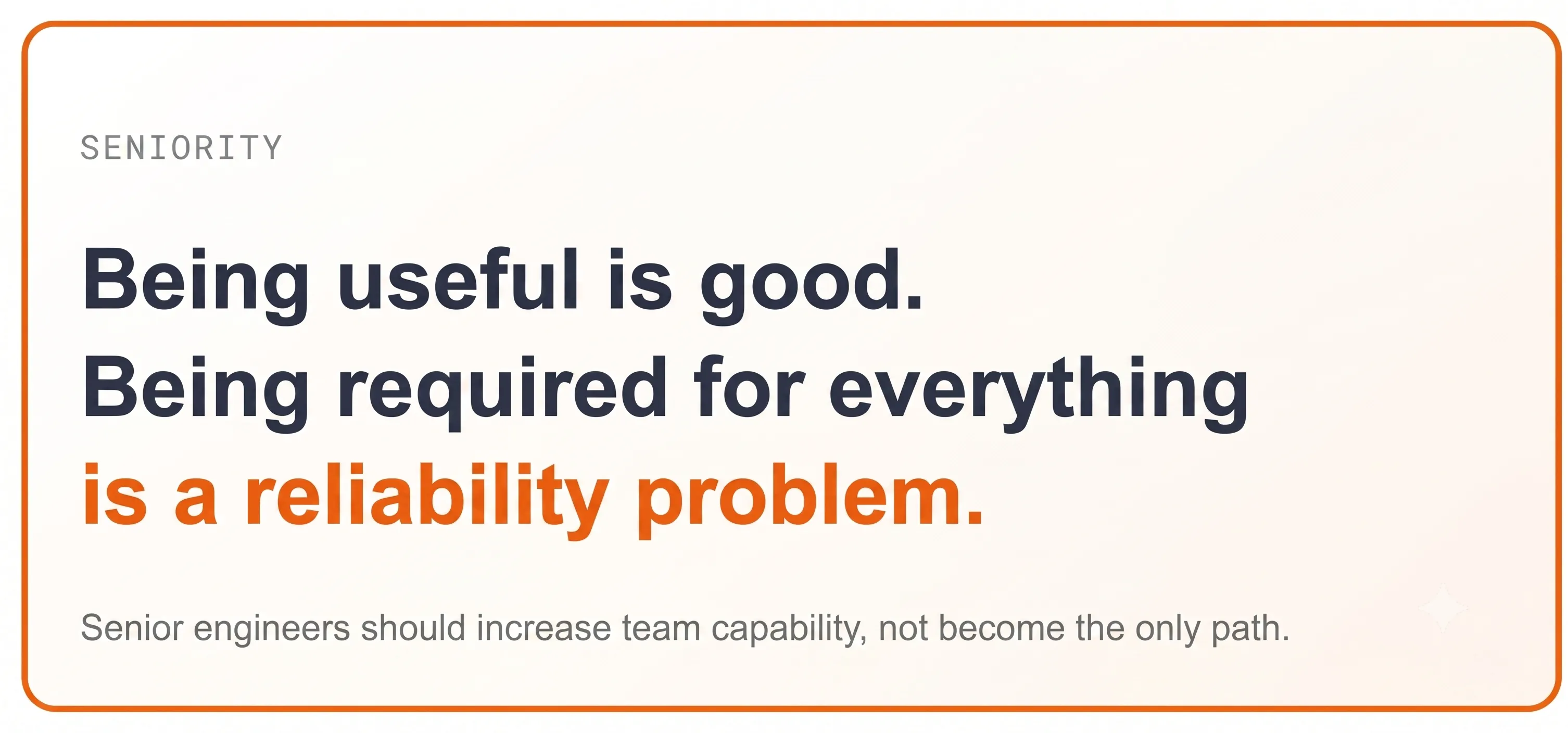
Senior engineers should increase team capability, not become the only path to production clarity.
What reducing ambiguity looks like
Reducing ambiguity is practical work. It is not motivational-poster energy, and it is not “alignment” as a vague corporate word. It shows up in small engineering habits:
| Situation | Ambiguous version | Clearer version |
|---|---|---|
| Incident | ”The app is down" | "The API is returning 5xx for 18% of requests since 14:32” |
| Architecture | ”Use Kubernetes" | "Use Kubernetes because we need horizontal scaling, deployment isolation and standard runtime operations” |
| Migration | ”We need to migrate to the new cluster" | "Move checkout-service traffic to cluster-v2 with a 5% canary, watching 5xx rates for 30 minutes before scaling” |
| Security | ”Improve IAM" | "Remove wildcard actions from production roles and replace them with service-specific permissions” |
| Data | ”Pipeline failed" | "The DAG succeeded, but the target table freshness is 9 hours behind the SLO” |
| Cost | ”AWS is expensive" | "Staging RDS cost increased 42% after the instance class change on June 12” |
| Delivery | ”Fix observability" | "Add RED metrics, dashboard and alert for checkout-api before production rollout” |
The clearer version makes action possible. That is the point. Clarity is not about writing more words, it is about removing room for wrong assumptions.
Strong opinions, loosely held
Senior engineers need opinions. Not random opinions, not tool loyalty, not “I used this once in 2017 and now everything else is wrong”. Useful opinions, built from incidents, migrations, outages, audits, cost reviews, bad deployments and late-night debugging.
But there is a second part: those opinions have to be loosely held. A strong opinion without curiosity becomes dogma. A flexible opinion without conviction becomes noise. The balance matters.
Weak opinion:
"We should use this because I like it."

Useful opinion:
"I prefer this option because it reduces operational ownership, keeps rollback
simple and avoids adding another stateful component. The trade-off is less
flexibility later."
The second version gives the team something to evaluate. That is seniority. Not being the loudest voice, being the clearest one.
The best senior engineers make the system calmer
There is a type of engineer who makes every room more anxious. Everything is urgent, everything is terrible, every decision is wrong, every tool is bad, every incident is proof that nobody listened. That is not seniority. That is stress with credentials.
The best senior engineers make the system calmer. Not by pretending problems are small, but by making them understandable. They separate symptoms from causes, identify what is known and unknown, explain trade-offs, cut options when too many are slowing the team down, document decisions, and turn vague risk into concrete next steps. They do not remove all uncertainty. They reduce enough of it for the team to move.
Final takeaway
Seniority is not a badge you earn by collecting tools. It is the ability to create clarity when the system is messy. Sometimes that means debugging a production issue, sometimes challenging an architecture decision, sometimes writing a better ticket, sometimes explaining risk to people who do not live inside the infrastructure every day.
The best senior engineers reduce ambiguity. They make problems easier to reason about, decisions easier to revisit, incidents easier to coordinate, and teams less dependent on guesswork. And when production gets creative, that clarity is worth more than another dashboard nobody knows how to read.